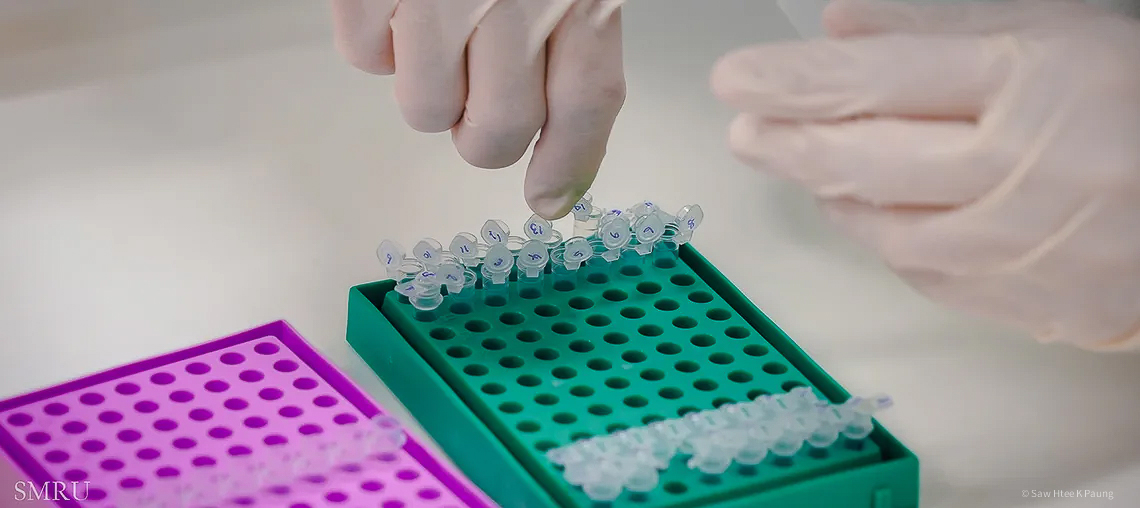
The central laboratories at SMRU provide diagnostic services and sample management in support to clinical care provided by SMRU in the fields of maternal and child health, malaria, tuberculosis and other infectious diseases.
Research activities led or supported by the laboratories in the same fields can be found in the general research activities section. They include: haematology, microscopy, microbiology, malaria in-vitro, and entomology laboratories.
haematology
The Haematology laboratory was set up in 2010 and supports SMRU clinical and research work through a variety of basic haematology testing (Complete Blood Count, RBC morphology, C-reactive protein, Haemogobin typing, G6PD deficiency tests). In coordination with PE team, the laboratory organises teaching, training and QC for G6PD deficiency and Point-Of-Care testing within SMRU and for external organizations. The laboratory is run by 1 research assistant, 2 laboratory technicians, 1 laboratory assistant, and 1 haematology research scientist.
Microbiology
The SMRU Microbiology department was established in 2006 to provide a diagnostic service for the SMRU patient population and to facilitate research on regionally important non-malaria infectious diseases. Since then it has expanded to include the molecular diagnostics including malaria. This department carries out a wide range of routine, surveillance and research activities in collaboration with the Oxford Tropical Network and other organisations as summarised below.
The department is staffed by one Molecular Microbiologist (department head), one senior laboratory technician, seven laboratory technicians, one senior laboratory assistant, four laboratory assistant and one specimen/equipment manager; with the addition of visiting students and volunteers. It participates in a number of external quality assurance schemes and is an active member of the MORU Tropical Health Network Clinical Microbiology Group, which aims include harmonising standard operating procedures across the network. In March 2020, it was registered as a certified laboratory for COVID-19 testing, awarded by the Department of Medical Science, Ministry of Public Health, Thailand.
Main Activities Diagnosis of infectious diseases using microscopy, culture, serology, molecular and protein profiling methods; Antibiotic sensitivity profiling for treatment and surveillance purposes; Response to the outbreaks using molecular diagnostics, for example Chikungunya and COVID-19; Bacterial/fungal identification using MALDI-TOF MS; Surveillance/diagnostic of the respiratory infections in the populations on the Thailand-Myanmar border; Providing microbiological support for the SMRU Tuberculosis programs, for example microscopic examination (AFB smear) and molecular diagnostic (GeneXpert); Providing microbiological support for SMRU maternal and child health activities, for example routine antenatal urine screening was introduced in 2012 for all pregnant women; Providing knowledge of infectious diseases to the community through Public Engagement team, for example Melioidosis, COVID-19; Providing specimen, equipment, and external lab referral management and obtain the permits to comply with the Pathogens and Animal Toxins Act.
microscopy
There are a total of 22 laboratory technicians working currently at S.M.R.U. They are all local people who have been trained by SMRU at various times since its inception in 1986.There are 16 lab technicians working in 4 clinics spread along the Thai-Myanmar border (from 125 km north of Mae-Sot to 60 km to the south). Their main activity is malaria diagnosis by microscopy (Giemsa stain). They are also able to perform Urine analysis, Stool examination, direct vaginal discharge examination, Haematocrit, Reticulocytes counts, G6PD deficiency rapid fluorescence test and G6PD Biosensor, Bilirubin measurement and Blood transfusion testing. They are also involved in a lot of blood sample processing including centrifugation and storage for various clinical studies.
Five senior lab technicians are working in S.M.R.U central lab in Mae-Ramat. Their main roles are to train and supervise lab technicians in the clinics, manage the staff, perform internal quality control, perform external quality control for various NGOs working in the region, perform second blind readings and third readings for clinical trials, reading malaria smears from malaria surveys, perform quality control on malaria rapid diagnostic tests (R.D.T) used in the field, manage supplies stocks and order, clean and maintain regularly microscopes and other equipment and data entering.
One lab technician is in charge of training and supervising staff (home visitors) performing malaria R.D.T and preparing malaria blood smears in the clinics. He is also involved with M.E.T.F (Malaria elimination Task Force) and exhaustive malaria surveys.
Our laboratories have been certified for registered studies through trainings and external QC by pharmaceutical companies such as G.S.K and Novartis. We follow the regular external quality control organized by the Thai Public Health and all our lab technicians achieved grade 1 in malaria parasites detection and specie identification during a WHO test evaluation in 2014.
.png)