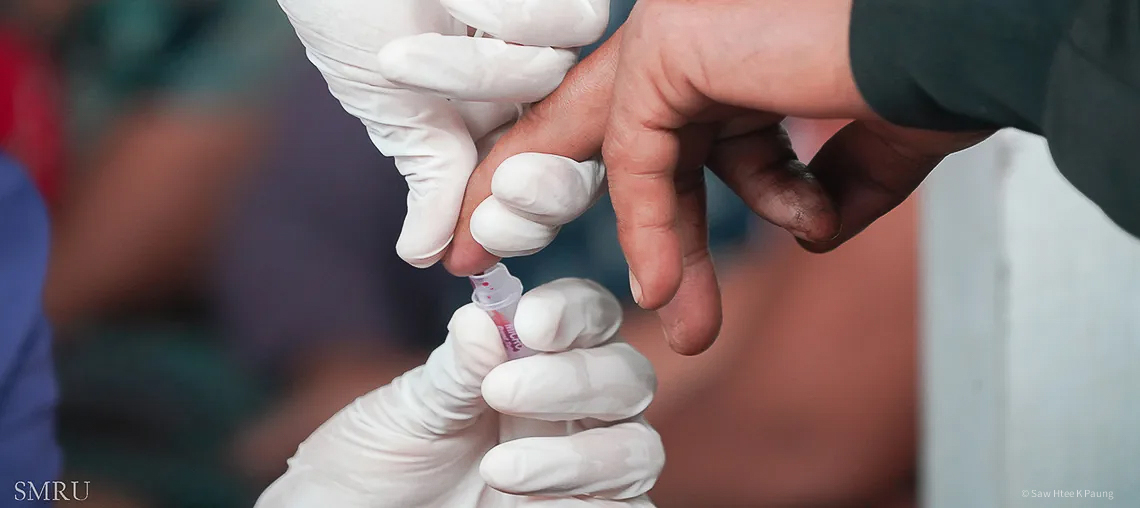
Malaria department

Shoklo Malaria Research Unit (SMRU) malaria program aims to support malaria elimination in Thailand and Myanmar by generating innovative, evidence-based tools for malaria elimination.

Malaria services for migrants (Migrant clinics)

Along the Thai-Myanmar border, malaria services are provided through Wang Pha and Maw Ka Thai migrants clinics which are situated in the Tak province, Thailand.

Malaria Elimination Task Force (METF)

Myanmar has one of the largest malaria burdens in the Greater Mekong Subregion (GMS). Throughout the GMS, Plasmodium falciparum parasites are increasingly resistant to artemisinin combination therapies. Given the lack of current alternative treatment options, one proposed solution is to eliminate P. falciparum from the region. Because of promising results, several small-scale elimination projects have been piloted in the GMS, including along the Myanmar-Thailand border. Encouraged by the pilot elimination project's success in reducing malaria cases along the Myanmar-Thailand border, the project was scaled up to encompass a large region of Eastern Kayin State, Myanmar.

Elimination of Plasmodium vivax imposes multiple challenges, including the prevalence of the G6PD deficiency, adherence to the long-course primaquine, and the presence of asymptomatic reservoirs among the communities living in the Kayin State.

To address these problems, METF was initiated in 2014 with Karen Community-Based Organizations (CBOs) and SMRU to eliminate artemisinin-resistant Plasmodium falciparum and relapsing Plasmodium vivax in Kayin State, Myanmar.

The overall strategies of METF are:

1. Geographic mapping of the communities residing in malaria risk area
2. Community engagement to increase awareness of early case detection and prevention
3. Generalize access to the early diagnosis and treatment
4. Epidemiological surveillance
5. Malaria prevalence surveys using highly sensitive diagnostic tools
6. Targeted accelerated interventions (mass drug administration)
7. Glucose-6-phosphate-deficiency testing and safe radical regimen for P.vivax
8.
Vector control interventions
9. Environmental Surveillance and Malaria Risk Assessment
10. Trans-border malaria surveillance (along the Thai-Myanmar border)

This  program has been co-funded by:

1. The Global Fund to fight against Malaria, Aids and Tuberculosis
2. The Bill and Melinda Gates Foundation
3. Wellcome

Program report and publications

1. Parker DM, Landier J, Thu AM, Lwin KM, Delmas G, Nosten FH, et al. Scale up of a Plasmodium falciparum elimination program and surveillance system in Kayin State, Myanmar. Wellcome Open Res. 2017;2:98.

2. Landier J, Parker DM, Thu AM, Lwin KM, Delmas G, Nosten FH, et al. Effect of generalised access to early diagnosis and treatment and targeted mass drug administration on Plasmodium falciparum malaria in Eastern Myanmar: an observational study of a regional elimination programme. Lancet. 2018;391(10133):1916–26.

3. Landier J, Parker DM, Thu AM, Carrara VI, Lwin KM, Bonnington CA, et al. The role of early detection and treatment in malaria elimination. Malaria J. 2016;15(1):363.

4. Rae JD, Nosten S, Kajeechiwa L, Wiladphaingern J, Parker DM, Landier J, et al. Surveillance to achieve malaria elimination in eastern Myanmar: a 7-year observational study. Malaria J. 2022;21(1):175.

5. Landier J, Kajeechiwa L, Thwin MM, Parker DM, Chaumeau V, Wiladphaingern J, et al. Safety and effectiveness of mass drug administration to accelerate elimination of artemisinin-resistant falciparum malaria: A pilot trial in four villages of Eastern Myanmar. Wellcome Open Res. 2017;2:81.

6. Legendre E, Lehot L, Dieng S, Rebaudet S, Thu AM, Rae JD, et al. Malaria temporal dynamic clustering for surveillance and intervention planning. Epidemics. 2023;43:100682.

7. Rae JD, Landier J, Simpson JA, Proux S, Devine A, Maude RJ, et al. Longitudinal trends in malaria testing rates in the face of elimination in eastern Myanmar: a 7-year observational study. Bmc Public Health. 2021;21(1):1725.

8. König A, Kajeechiwa L, Thwin MM, Nosten S, Tun SW, Tangseefa D, et al. Community engagement for malaria elimination in contested areas of the Karen/Kayin State, Myanmar: A case study on the Malaria Elimination Task Force. Wellcome Open Res. 2018;3:22.

9. Landier J, Haohankhunnatham W, Das S, Konghahong K, Christensen P, Raksuansak J, et al. Operational Performance of a Plasmodium falciparum Ultrasensitive Rapid Diagnostic Test for Detection of Asymptomatic Infections in Eastern Myanmar. J Clin Microbiol. 2018;56(8):e00565-18.

10. Jacob CG, Thuy-Nhien N, Mayxay M, Maude RJ, Quang HH, Hongvanthong B, et al. Genetic surveillance in the Greater Mekong subregion and South Asia to support malaria control and elimination. Elife. 2021;10:e62997.

11. Imwong M, Dhorda M, Tun KM, Thu AM, Phyo AP, Proux S, et al. Molecular epidemiology of resistance to antimalarial drugs in the Greater Mekong subregion: an observational study. Lancet Infect Dis. 2020;20(12):1470–80.

12. Thu AM, Phyo AP, Pateekhum C, Rae J, Landier J, Parker DM, et al. Molecular markers of artemisinin resistance during falciparum malaria elimination in Eastern Myanmar. 2024;

13. Thu AM, Phyo AP, Landier J, Parker DM, Nosten FH. Combating multidrug‐resistant Plasmodium falciparum malaria. FEBS J. 2017;284(16):2569–78.